KPI Overview
On this page you can explore the costs and the revenues from different perspectives, supported by the following sections:
Overview
There are two components of an objective, namely Cost and Revenue.
Revenue includes:
Total Physical Revenue, which is Customer related.
Custom Objectives of the ‘Revenue’ type. Each Custom Objective may have revenue data in the following categories: Customer, Supply (Fixed, Variable, Open/Close), Production (Fixed, Variable, Open/Close), Warehouse (Fixed, Variable, Open/Close), and Transport.
Cost includes:
Total Physical Cost, which comprises the categories mentioned previously.
Custom Objectives of the ‘Cost’ type. Each Custom Objective may have cost data in the Customer, Supply, Production, Warehouse, and Transport categories.
The three widgets at the top of this page show the breakdown of the costs and the revenue as described above.
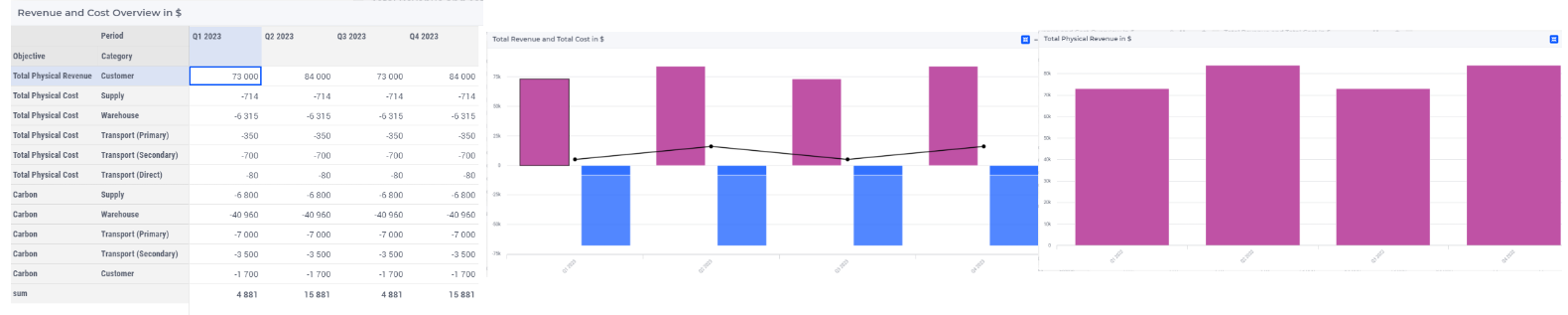
The first table displays precise figures of revenue and cost, while the middle bar chart presents a visual representation of those figures in Total Physical Revenue, Total Physical Cost, and Custom Objectives. On the middle bar chart the total profit is shown with a black line together with the revenue (purple) and cost (blue). The bar chart on the right-hand side shows a more detailed breakdown of the figures in the previous chart by categorizing them into five different groups: Customer, Supply, Production, Warehouse, and Transport. The content of this bar chart depends on which category (Total Physical Revenue, Total Physical Cost, or a Custom Objective) is selected in the first table. The selected element will get a black border. For example, if you click on the warehouse carbon cost for the first period (-40960), on the middle bar chart this element of the total cost will get a black border, and the bar chart on the right-hand side will show the Carbon cost, where the warehouse component of the first period will get a black border (see the picture below).
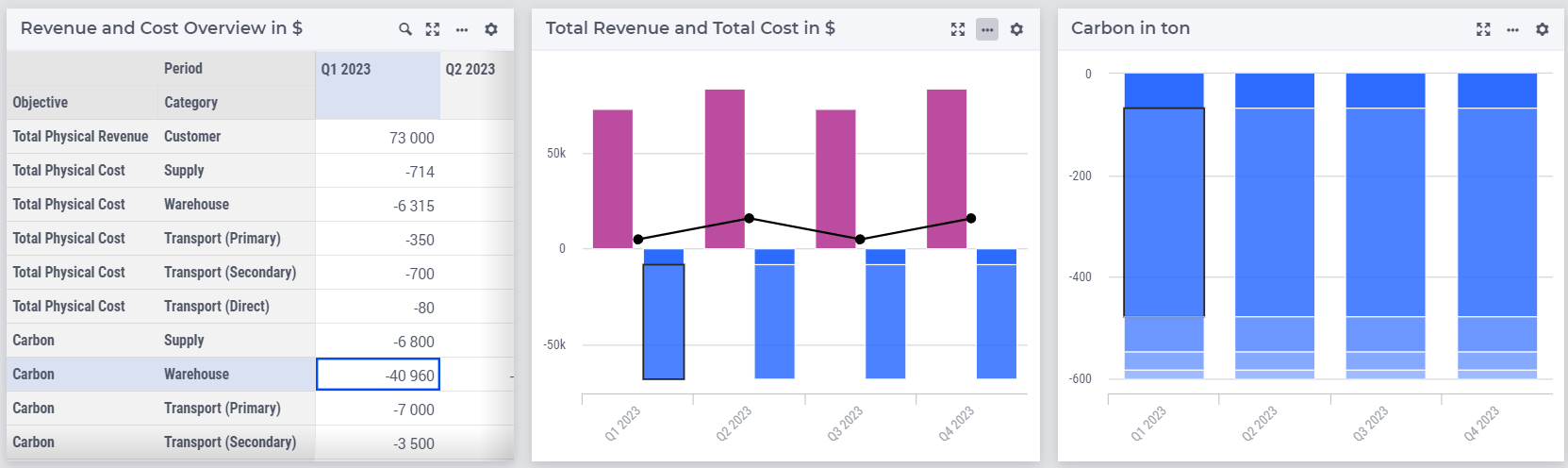
It is worth mentioning that if the dataset contains only cost data and lacks revenue data, then the cost values will be presented as positive. The table and the middle bar chart display values in the default currency; the bar chart on the right-hand side uses the unit of the selected objective, for example tons for the Carbon objective in the picture above. The two bar charts show revenue in purple and cost in blue.
For example, in the picture above, the Total Physical Revenue from the Customer in Q1 2023 is 73,000 and the Total Physical Cost of the Warehouse in Q1 2023 is 6,315.
Tables On The Page
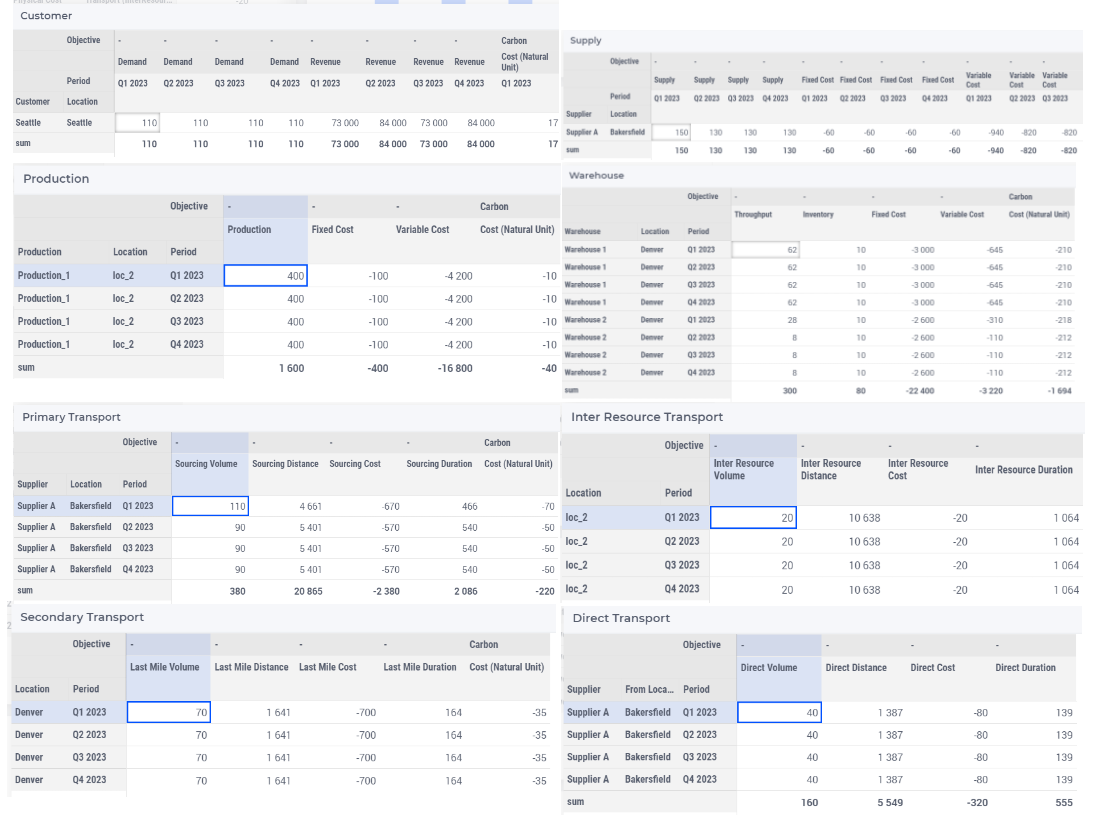
These tables show more detailed information about the revenue/cost and demand/volume for Customer, Supplier, Production, Warehouse, and Transport, but the data is not as detailed as the content of the tables on the other result pages. For example, these tables don’t show information about capacity. For costs, these tables show only the main cost types, such as:
Fixed Cost
Variable Cost
Closing/Opening Cost
Note
In the Warehouse table, when there is “Inventory Available” in the dataset, the “Throughput” column is split into separate Inbound and Outbound columns.